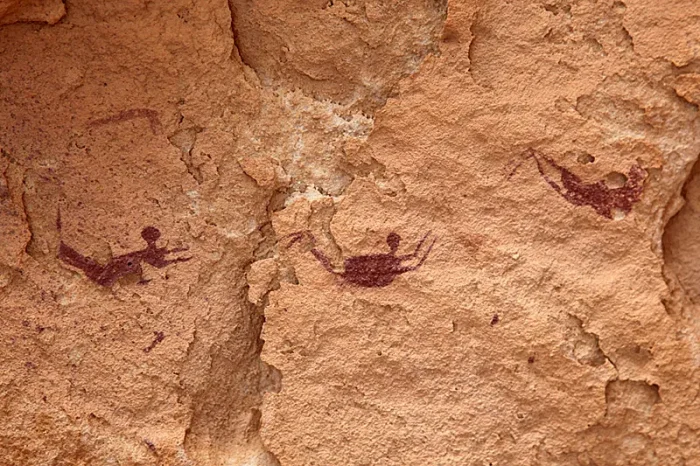
There is a rock shelter wall in one of the driest deserts on Earth on which human figures are depicted with limbs bent as though they are swimming through water. Painted sometime between six and a half and eight and a half thousand years ago, the figures were discovered by a research group in October 1933 in a place called Wadi Sura — Arabic for “valley of pictures” — along the remote western edge of the Gilf Kebir plateau of the Sahara Desert in southwestern Egypt.
Leading that small party was thirty-eight-year-old Hungarian aviator and desert explorer László Almásy, who had spent years crossing the Sahara in open-cab trucks, cataloging rock art throughout the region. Traveling with him on this expedition were Leo Frobenius, a German ethnologist who had spent three decades documenting rock art across Africa, his colleague Hans Rhotert, and a young artist named Elisabeth Pauli, who would spend days in the heat reproducing the paintings.
To Almásy, the discovery of the figures had not come as a complete surprise. Surveying roughly 150 kilometers to the south above a desert spring called Ain Dua six months earlier, he and his colleagues had found an extensive complex of prehistoric rock art, including hundreds of images of cattle and animals, among them antelope, giraffe, and elephant — none of them native to the desert surrounding him.
He considered two explanations: that the artists had come from other regions and painted animals they knew firsthand, or that those animals had once lived in a Sahara not yet turned to desert.
The swimmers at Wadi Sura settled the question for him. He concluded the paintings were relics of a wetter Sahara.
Almásy would turn out to be right, though the proof did not come from the paintings as the debate about whether the figures depict people swimming or something more symbolic remains unsettled among archaeologists to this day. Instead, the confirmation came later, from geologists and sediment researchers who found evidence of a wetter, more habitable Sahara independent of the rock art itself.
Decades later, the Cave of Swimmers and a highly fictionalized Almásy entered popular culture through Michael Ondaatje’s 1992 novel The English Patient and its 1996 film adaptation. The novel drew loosely from Almásy’s life, and both versions gave the cave a central role. The film did not use the original shelter at Wadi Sura. Its cave scenes were staged at a site in Tunisia, with paintings created for the production.
Today, the tracks left in the sand by Almásy’s expedition and those that came earlier still lie undisturbed across the desert surface. And the figures of the people who appear to be swimming in a Sahara before it became a desert continue to live on the walls.
Note: read a history snapshot about The First Transcontinental Telephone Call.
Sources:
- Batonai, Alexandra. “‘Abu Ramla’: László Almásy’s Short Biography.” Journal of Central and Eastern European African Studies, vol. 3, no. 2, 2023, pp. 30-50, https://jceeas.bdi.uni-obuda.hu/index.php/jceeas/article/view/154/305
- “Cave of Swimmers, Egypt.” British Museum, africanrockart.britishmuseum.org/country/egypt/cave-of-swimmers/.
- Kubassek, János, et al. “The World-Famous Desert Researcher, Geographic Explorer László Almásy, Who Explored the Last White Spots in the Sahara. ‘The English Patient.’” Dynamiques environnementales, vol. 39-40, 2017, journals.openedition.org/dynenviron/422.
- Painted human figures in the Cave of Swimmers, Wadi Sura, Gilf Kebir. Photo: Roland Unger, CC BY-SA 3.0, via Wikimedia Commons, https://commons.wikimedia.org/wiki/File:WadiSuraSwimmers.jpg
- Riemer, Heiko. “Dating the Rock Art of Wadi Sura.” Wadi Sura — The Cave of Beasts: A Rock Art Site in the Gilf Kebir (SW-Egypt), edited by Rudolph Kuper, Heinrich-Barth-Institut, 2013, hbi.uni-koeln.de/files/media/PDF/Buecher/Wadi_Sura/AP26_38-41_riemer_dating.pdf.
- “The Cave of Swimmers, Egypt — The Rock Art of Gilf Kebir.” Bradshaw Foundation, bradshawfoundation.com/africa/gilf_kebir_cave_of_swimmers/index.php.
Discover more from Historical Snapshots
Subscribe to get the latest posts sent to your email.

