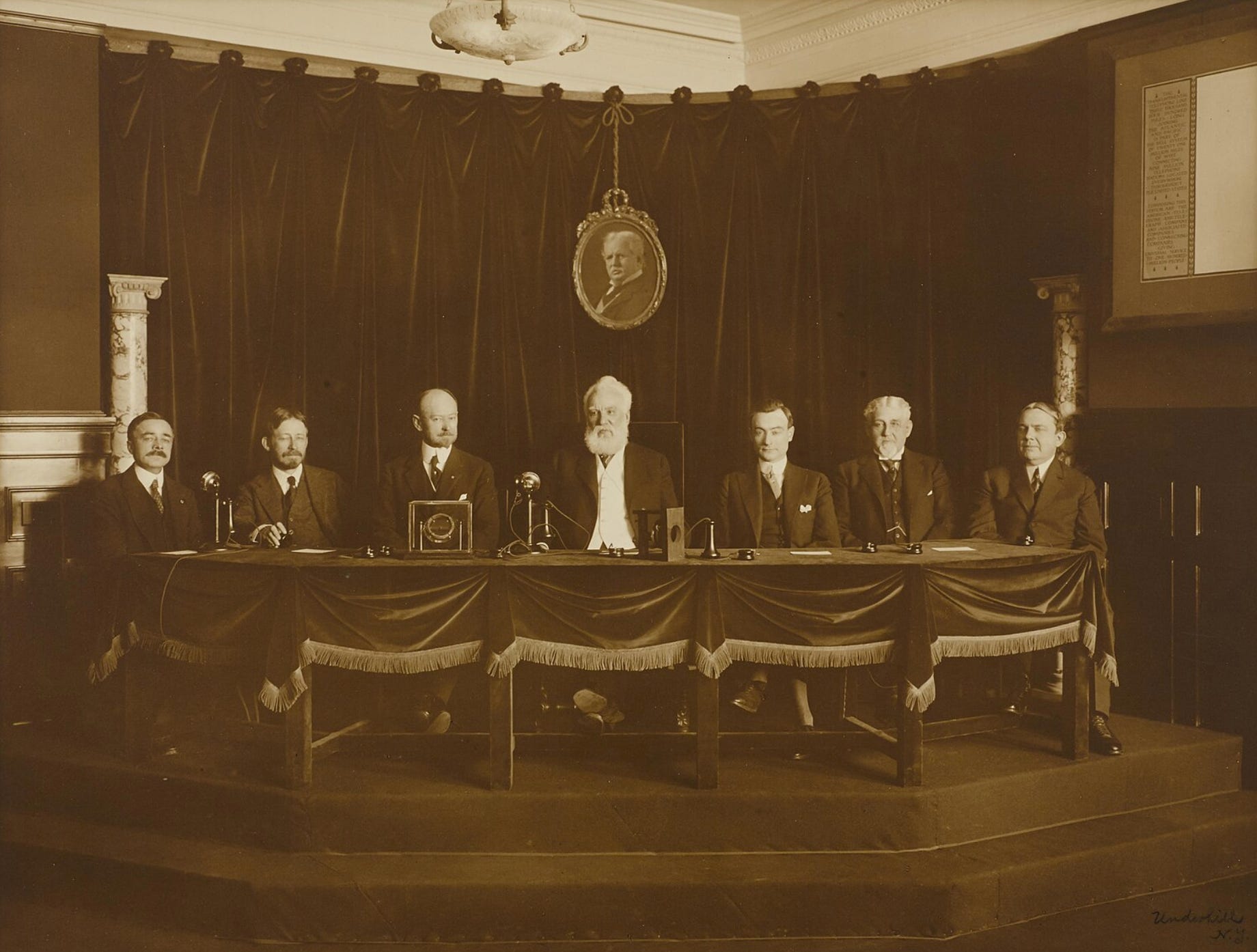
Two and a half years had passed since the earthquake and fires that devastated San Francisco on April 18, 1906. And despite an astonishingly fast rebuilding effort, the city still bore many marks of the tragedy when John Joseph Carty arrived in the fall of 1908.
Carty was forty-seven, the son of an Irish immigrant. In his youth, he had expected to attend Harvard, but at seventeen his eyes began to give out, and rather than fall behind his classmates, he left school and took a job. Not long after, he wandered into the office of the Boston Telephone Despatch Company and was hired as an operator. Telephony had been his work ever since.
Now he was the Chief Engineer of the American Telephone and Telegraph Company (AT&T), and he had been sent west with a few assistants to help rebuild and enlarge the local Bell telephone company’s earthquake-damaged plant, and to design a larger, more permanent system as the city took shape around them.
The rebuilding work itself was within familiar territory. But a separate issue had been raised by San Francisco’s civic and business leaders: there was no cross-country telephone service to or from San Francisco. Carty could call cities on the West Coast and some further inland. But he could not call New York, or Chicago, or anywhere east of Omaha. At the time, the country had two telephone networks, an eastern and a western one, with no connection between them.
The reason was a limitation of physics. The human voice, sent down a copper wire as an electrical current, gets weaker as it travels. Past a certain distance, it fades. AT&T connected New York and Chicago in 1892 using heavy copper wire. Loading coils, first deployed around the turn of the century, then pushed the workable range steadily westward, carrying long-distance service deeper into the interior of the country.
San Francisco, however, lay roughly a thousand miles further west, across the Rockies, the Great Basin, and the Sierra Nevada. No existing technology could carry a clear, reliable telephone conversation across that gap. The only ways to reach New York from California were the ones that had served the country for about half a century: a five-day train ride, a letter, or a telegram — the latter being fastest, but limited to short messages sent back and forth, not conversation.
“I was greatly impressed,” Carty told a Californian later, “with the isolation of the rest of the country.”
That isolation was becoming increasingly significant, especially as San Francisco looked toward a great celebration tied to the expected opening of the Panama Canal in 1914. For a city on the Pacific, the canal promised to cut the sea route from New York to San Francisco from a journey of months around Cape Horn to roughly three weeks by steamship. San Francisco decided to host a world’s fair to mark the occasion and to show that, after the earthquake and fire, the city was back. It would be called the Panama-Pacific International Exposition and was expected to attract millions of visitors.
The message from San Francisco’s leaders to Carty was clear. By the time the fair opens, they made clear, we want to be able to call New York from San Francisco.
Carty worked on the problem with his assistants night after night. They got nowhere. He went home to New York with the problem unsolved. But the commitment to solve it began to harden. Within a year, AT&T president Theodore Vail had made the transcontinental line a company priority. By 1911, Carty was publicly promising that a line from New York to San Francisco would be in place in time for the fair. Yet he still did not know how it would be built. He had staked his reputation, Vail’s trust in him, and the credibility of corporate research itself on something existing technology did not yet permit.
What he needed was a device that could take a weakened signal and make it strong again — in effect, a relay station that listened to the dying voice on one end of a wire and spoke a fresh, full-strength copy of it down the next stretch. Engineers called this amplification. The device that would do it was called an amplifier.
What followed was, in the phrase of one of Carty’s protégés, Frank Jewett, “a mad scramble to find means to cope with a vast new problem before a fixed date.” Carty hired a young University of Chicago physicist, Harold Arnold, and put him in charge of a research laboratory at Western Electric in New York. Arnold was given a team of about twenty-five researchers, a substantial budget, and one objective: to find a way to carry a voice across the continent.
The work went slowly. At first, the researchers looked for an answer in the familiar tools of the electrical age: magnets, coils, relays, and the delicate vibrating parts used inside telephones. This made sense. A telephone already performed a kind of miracle every time someone spoke into it: the pressure of a human voice moved a thin diaphragm; that movement was translated into an electrical current; and another diaphragm at the other end turned that current back into sound. Perhaps some version of that familiar machinery could be adapted along the route.
But in practice, the voice was too subtle for such machinery. A telephone signal was not a simple click, like a telegraph message. It rose and fell, carrying all the small variations that made one voice sound different from another. The mechanical and magnetic devices distorted those variations or failed to strengthen them cleanly enough. Whatever device succeeded would have to amplify the voice without mangling it.
Meanwhile, Carty was not sleeping much. Jewett, writing about him years later, said: “He drove himself and his associates with a force that was untiring and unsparing. Sleep and relaxation in small doses were grudgingly accorded.”
Subscribe to get access
Read more of this content when you subscribe today.
Discover more from Historical Snapshots
Subscribe to get the latest posts sent to your email.
