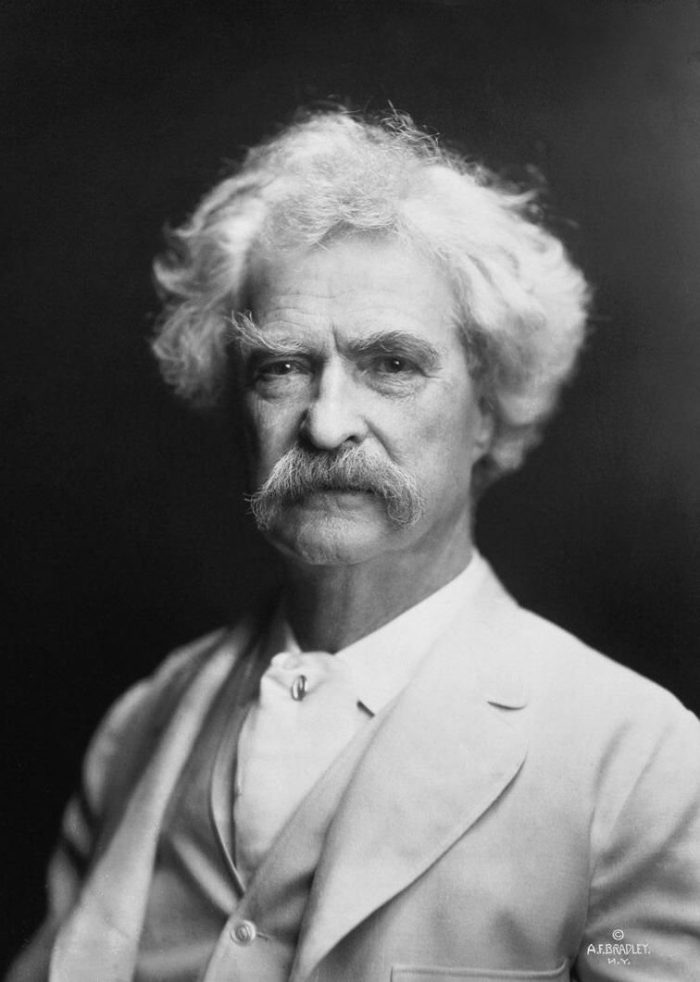
The hearing room in the main Library of Congress building was already crowded when Mark Twain arrived on the morning of December 7, 1906. Authors, publishers, lawyers, and several members of Congress had gathered for a contentious discussion on copyright reform.
After entering the room, Twain removed his overcoat. Reporters later remarked on the startling effect. There Twain stood, dressed in an immaculate, three-piece white suit at a winter political hearing in Washington, D.C. “Nothing could have been more dramatic than the gesture with which he flung off his long loose overcoat, and stood forth in white from his feet to the crown of his silvery head. It was a magnificent coup, and he dearly loved a coup,” wrote a prominent writer friend of Twain’s.
Twain later explained his clothing choice to The Washington Post: “I have reached the age where dark clothes have a depressing effect on me. I prefer light clothing, colors, like those worn by the ladies at the opera.”
His comment was understandable. He had been grieving for years. Though socially revered for many books, the decades prior had brought Twain profound hardship. He had dealt with financial ruin during the economic panic of 1893, leaving him responsible to nearly 100 creditors. The burden drove him into a demanding around-the-world lecture tour to repay the debts to everyone; a task he completed, but at great personal cost. Then, his daughter died in 1896 at just twenty-four. And then his beloved wife died in 1904 after a long illness.
So, yes. Perhaps the white suit was a small gesture toward levity, a flicker of lightness he could control. But Twain was also masterful with timing and with using humor to change the atmosphere of a room. Even in his later years, when performing wearied him, he still understood how to make an entrance and how to command attention. That ability to shape a room’s mood had been part of his genius from the beginning, a quality that would later amplify the fame his writing first earned him.
And so perhaps the white suit may also have been his way of transforming a potentially mundane Congressional proceeding into something more memorable and unmistakably his.
Still, for a society run by rigid rules, even a simple aberration of a white suit, normal for a summer day, but not for winter and not for a political gathering, sent all into upheaval. The effect truly was magnificent. The Post’s story the following day carried the headline: “Twain’s Fancy Suit.”
But the matter under discussion that day was serious. Twain was there to advocate for extending copyright protection for writers. He told the room in the dry manner that made even his serious remarks memorable, “I like that extension from the present limit of copyright life of 42 years to the author’s life and 50 years after. I think that will satisfy any reasonable author, because it will take care of his children. Let the grandchildren take care of themselves.”
The legislation would fail to pass and would not become law until the 1976 Copyright Act. But the story of that day was Twain and his white suit.
“All modern American literature comes from one book by Mark Twain called Huckleberry Finn.” – Ernest Hemingway
Life began for Mark Twain as Samuel Langhorne Clemens. Born in 1835 in the tiny village of Florida, Missouri, he spent his childhood in nearby Hannibal, a rough-edged river town with muddy streets and busy docks. In the future, it would become the imaginative landscape of Tom Sawyer and Huckleberry Finn. But back then, it was home for boyhood adventures that lay amidst a world surrounded by slavery and loss.
When Samuel was eleven, his father died at 49 from what was likely pneumonia. That loss alone was painful for the boy, but whatever time he had to grieve was quickly replaced by the family’s financial need. He went to work in his older brother Orion’s print shop in Hannibal, first running errands and setting type, then gradually learning the demands of the trade, which were often unpleasant. Printing offices were hot and loud. But as difficult times can sometimes bring about unexpected openings, they introduced him to a world of words.
By his mid-teens, Samuel had begun contributing occasional sketches to Orion’s newspaper in the form of brief comic pieces, portraits of local characters, and early attempts at satire. The writings were modest, but they revealed a voice that blended sharp observation with mischievous humor.
At seventeen, Samuel left Hannibal and began traveling as a journeyman printer, working in cities such as St. Louis, New York, Philadelphia, and Cincinnati. The work kept him fed, but the river still held his imagination. And not long after, he turned toward the ambition that many Hannibal boys seemed to harbor — becoming a steamboat pilot. “Pilot was the grandest position of all,” he later wrote, remembering the awe in which the profession was held and the princely salary it commanded.
Under the guidance of a seasoned pilot, Samuel mastered the Mississippi’s shifting channels, moods, and dangers. These years would leave a lasting impact and provide him with material for stories. But most importantly, they would give him the name by which the world would know him.
Subscribe to get access
Read more of this content when you subscribe today.
Discover more from Historical Snapshots
Subscribe to get the latest posts sent to your email.
