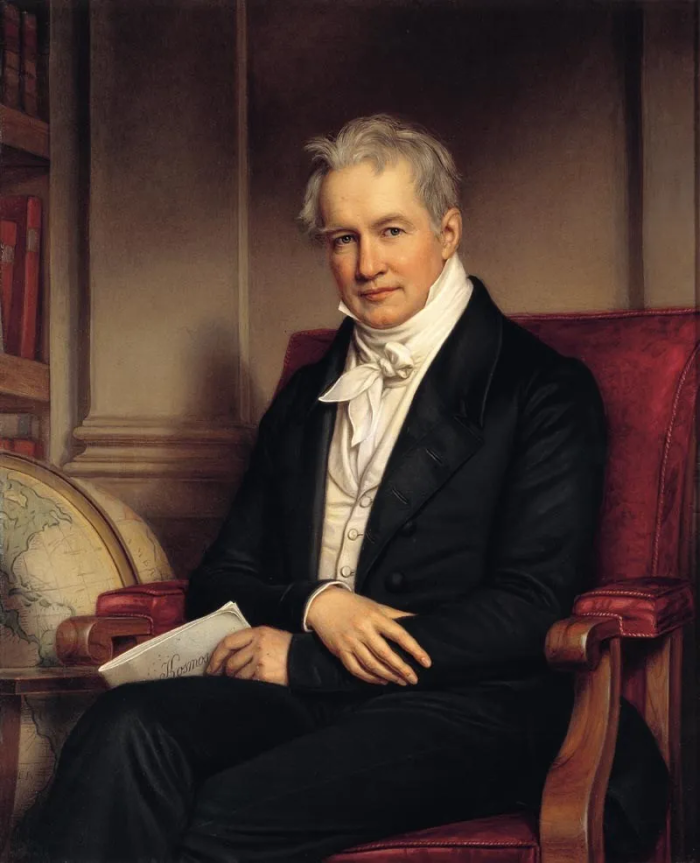
“Humboldt was one of those wonders of the world, like Aristotle, like Julius Caesar, like the Admirable Crichton, who appear from time to time, as if to show us the possibilities of the human mind, the force and the range of the faculties — a universal man, not only possessed of great particular talents, but they were symmetrical, his parts were well put together. As we know, a man’s natural powers are often a sort of committee that slowly, one at a time, give their attention and action; but Humboldt’s were all united, one electric chain, so that a university, a whole French Academy, travelled in his shoes.”
— Ralph Waldo Emerson, remarks at the centennial celebration of the birth of Alexander von Humboldt, September 14, 1869
Alexander von Humboldt was born in 1769 into a Prussian estate northwest of Berlin that he would later call the Castle of Boredom. It was cold and formal, and full of tutors hired to turn Alexander and his older brother, Wilhelm, into civil servants. This was the dream of their ambitious and emotionally distant mother, who, after their father’s death when Alexander was nine, became their sole caretaker. She devised a plan for their careers. And it was not open to discussion.
Wilhelm took to his books and became what their mother envisioned — philosopher, linguist, diplomat. Alexander would as well, but first he fell in love with nature. As a small boy, he roamed the nearby forests, filling his pockets with insects and plants and shells until the family called him, with some affection and some exasperation, “the little apothecary.” He also imagined more distant adventures after reading about the voyages of explorers and spending long hours over maps of unexplored territories. Years later, he would write,
“From my earliest youth I had been possessed by a passionate desire to travel in far-off countries, little visited by Europeans … Having grown up in a country lacking direct contact with the two Indies and settled later in mountainous country far from the sea-coast and famed mainly for its intensive mining industry, I sensed an ever-growing impulsion towards the sea and extensive journeys … All that which is far off and only indistinctly discernible captivates the imagination.”
For the time being, however, imagination had to yield to duty. He attended university at his mother’s insistence, and afterward entered government service as a mining inspector. She had her way. Yet in directing him so forcefully, she also, perhaps without intending it, gave shape to the discipline and breadth of learning that would later serve him so well.
Alexander threw himself into the work with the same restless energy he brought to everything. He revitalized old gold mines so successfully that production in his first year surpassed that of the previous eight years combined. He designed a safety lamp for miners, tested it himself underground, fainted from the fumes, recovered, and descended again. He founded a free school for workers at his own expense and helped establish relief support for miners and their families after accidents. By every outward measure, he was exactly the useful man his mother had intended to produce.
But by 1794, he was twenty-four, and feeling unsettled and disappointed. “I was forced into a thousand constraints,” he would later say of those years. In a letter to a friend, he put it more bluntly: “My unhappy circumstances force me to want what I can’t have, and to do what I don’t like.” In another, he reached for a stranger and more vivid image. There was, he wrote, “a drive” in him that made him feel as though he were losing his mind, like a man being chased by “ten thousand pigs.”
Meanwhile, Wilhelm had taken up a position at the university in Jena, a small town that had become one of the most intellectually vibrant places in Europe. Nearby, in Weimar, lived Johann Wolfgang von Goethe, already famous as Germany’s greatest living poet. But Goethe was more than a literary giant. He was also seriously engaged in science, developing theories of plant metamorphosis and color, and thinking deeply about the relationship between the observer and the natural world.
Wilhelm invited Alexander to visit. The experience would prove to be one of his most important in Alexander’s life.
Subscribe to get access
Read more of this content when you subscribe today.
Discover more from Historical Snapshots
Subscribe to get the latest posts sent to your email.
